Welcome to LIMAP’s documentation!
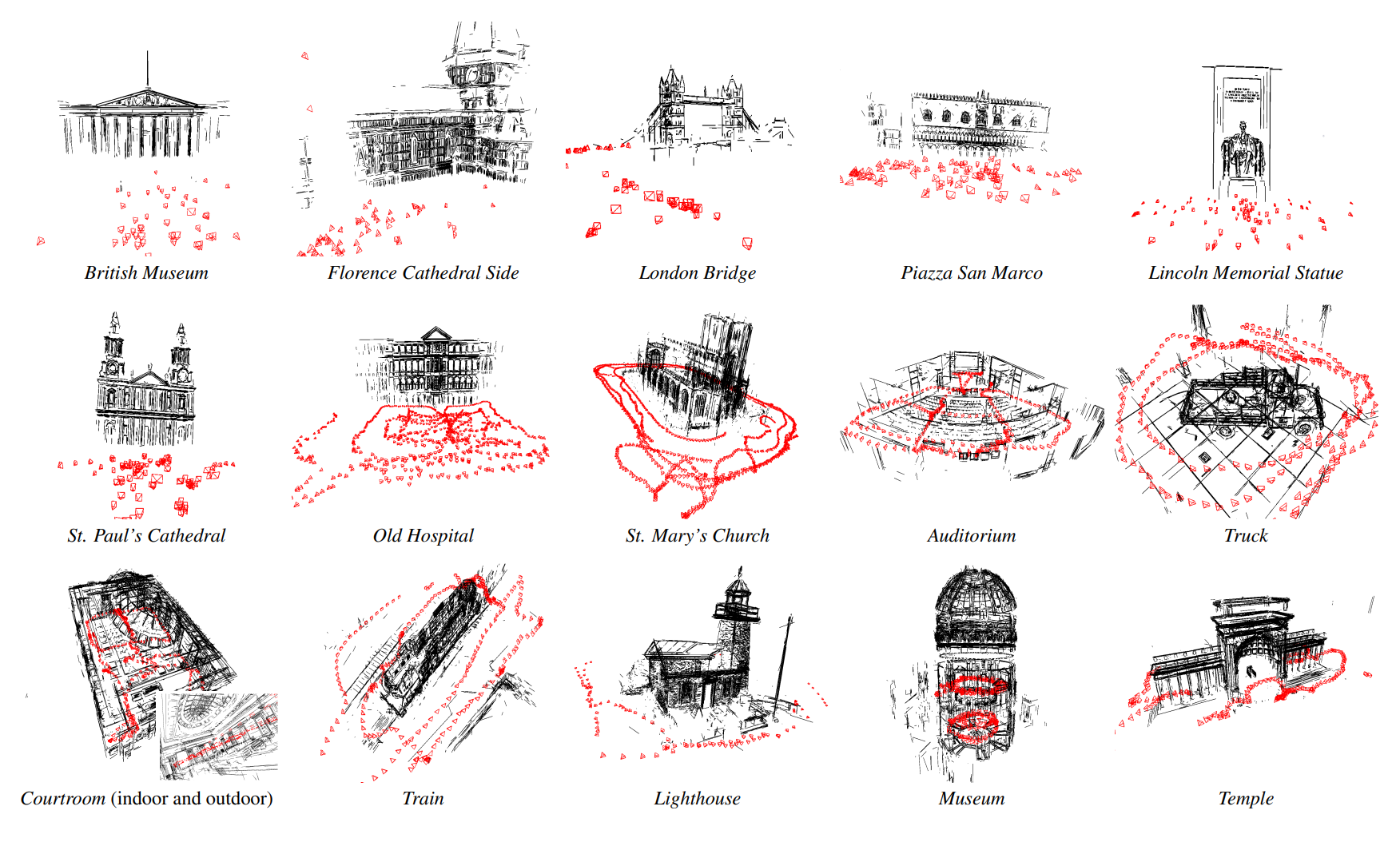
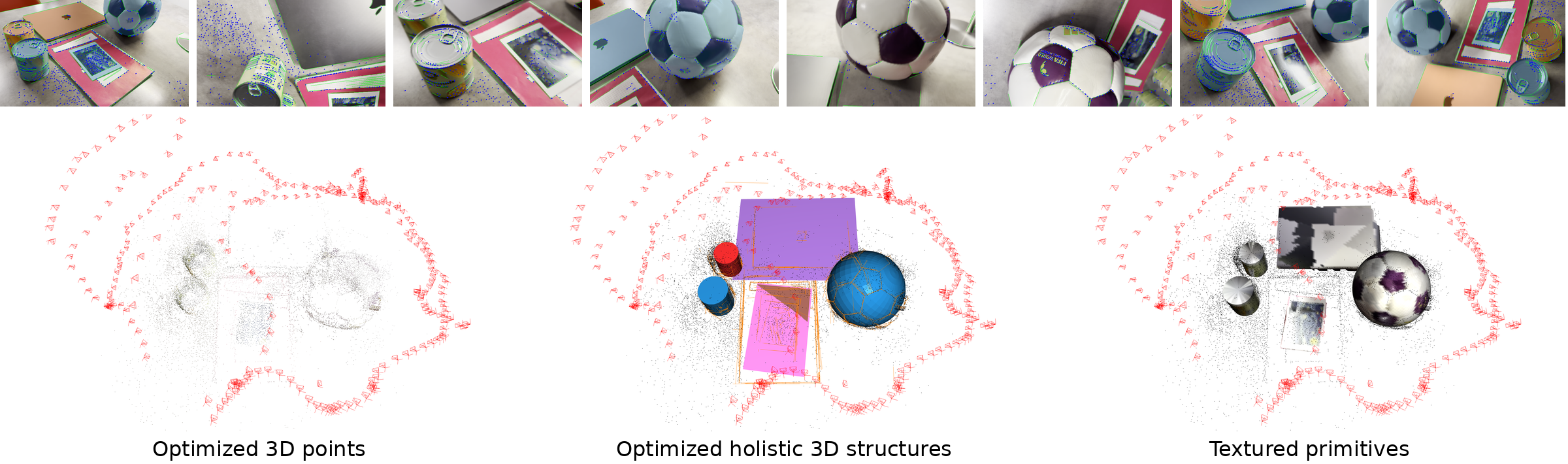
LIMAP is a toolbox for holistic 3D mapping, localization and structure from motion (SfM) with structured features. Alongside keypoints, it treats lines, vanishing points, planes, parametric primitives (spheres, cylinders, ellipsoids, cuboids, cones) and the wireframe connecting them as first-class citizens of the reconstruction, optimized jointly with the camera poses. It grew out of the highlight paper 3D Line Mapping Revisited at CVPR 2023 in Vancouver, Canada, with the SfM pipeline introduced and further improved in subsequent papers at ECCV 2024 and ECCV 2026. Contributors to this project are from the Computer Vision and Geometry Group at ETH Zurich.
Three pipelines are provided:
Visual mapping / triangulation – build a holistic 3D model from images whose camera poses are already known, for instance from an existing COLMAP reconstruction.
Visual localization – estimate the camera pose of a query image with respect to an existing 3D model, using point and line correspondences jointly.
Holistic incremental SfM – recover the camera poses and the 3D model together from images alone, with nothing given as input.
Note
Starting from LIMAP 2.0.0, the toolbox is fully compatible with the COLMAP ecosystem (version 4.2.0 as of Sep 1, 2026): a reconstruction is written as a plain COLMAP model, with the line, group and wireframe structures alongside it under structures/, so any output can be opened in COLMAP GUI and read with pycolmap. The unification runs deeper than the file format: the point side of the pipeline comes directly from COLMAP, consolidating with its scene types, database, estimators, correspondence graph, and various incremental mapper logic, with LIMAP adding the structures on top instead of maintaining a parallel implementation. Advances on the COLMAP side therefore carry over directly: multi-camera rig support, improved two-view geometry estimation, etc.
The line detectors, matchers, vanishing point estimators and plane detectors are abstracted behind registries to ensure flexibility to support recent advances and future development.
Tutorials:
API references:
Community: